
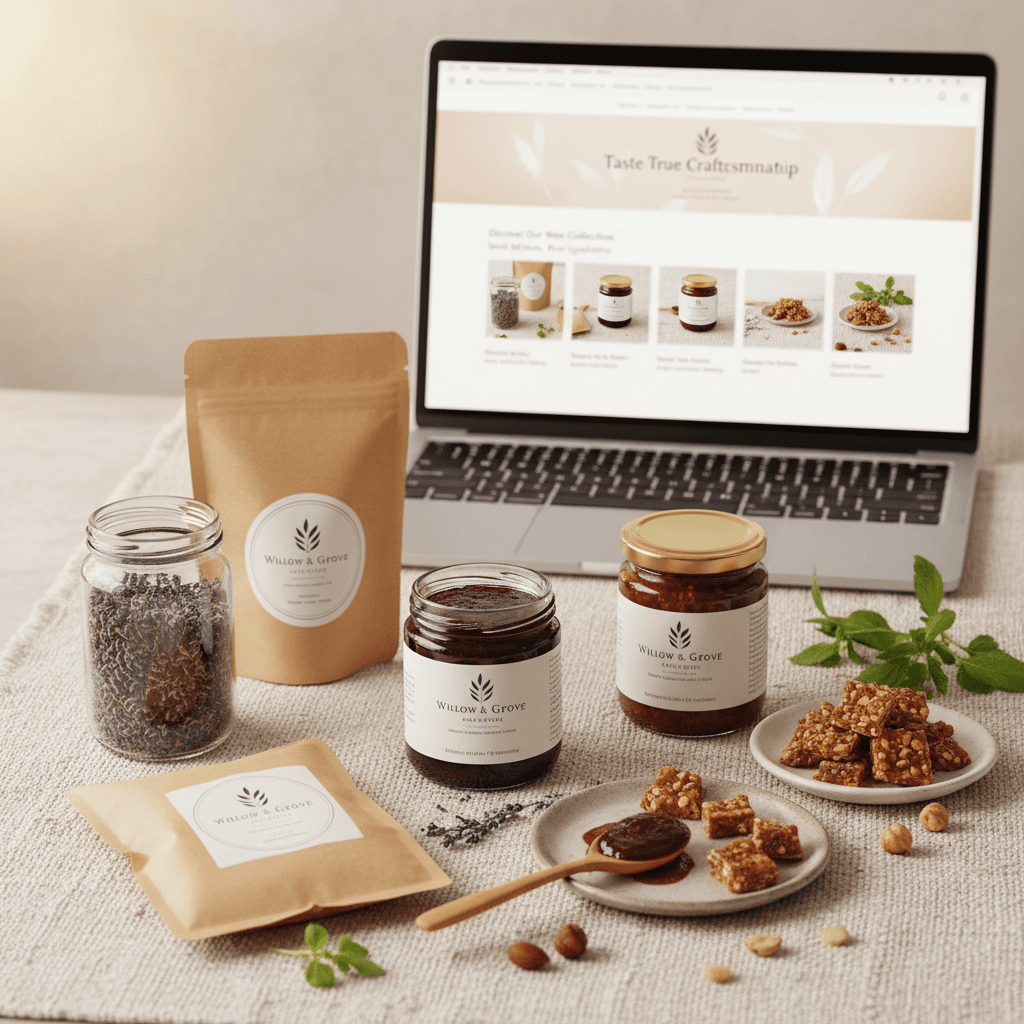
There is a specific feeling you get when you open a marketing email from a brand you like and think, "this could have been sent by anyone." The copy is fine. The design is clean enough. But nothing about it tells you anything specific about the brand, its personality, or why it is different from every other store selling similar things. Shopify email campaigns that feel generic are not a minor inconvenience — they are a brand problem that quietly costs you money in unsubscribes, ignored promotions, and customers who never build the loyalty that makes a DTC business sustainable.
The good news is that the genericness problem has specific causes, and once you understand them, fixing it becomes straightforward — especially with modern AI tools that approach brand voice differently than templates do.
The Genericness Problem: Why Most Shopify Email Campaigns Look and Sound the Same
Open your inbox and look at five marketing emails from small DTC brands. The chances are high that at least three of them share the same structure: a banner image with a headline overlay, a product shot below, a paragraph of copy that mentions "crafted with care" or "made for you," and a button that says "Shop Now." Maybe a footer with social icons.
This is not an accident. It is the result of an ecosystem of tools, templates, and best practices that have been shared, copied, and reinforced across the Shopify merchant community until they became the default. The design is the Klaviyo default template. The copy structure is from a blog post about email marketing best practices. The subject line is something like "New arrivals you will love."
Every individual decision seemed reasonable. Collectively, they produced something that looks exactly like everyone else.
Root Cause 1: Template Addiction
Klaviyo and every other ESP offer pre-built templates because templates reduce the barrier to sending. They work. But when everyone uses the same five templates with minor color and logo swaps, the visual distinctiveness that should make your brand recognizable disappears.
The template problem is not just visual. Templates also impose a content structure: header, product section, copy block, CTA. That structure is fine for some campaigns and wrong for others. A brand that wants to tell a founder story, introduce a limited collaboration, or share something behind the scenes is forced to cram that content into a product-focused template because it is what the tool makes easy.
The result is emails that have the shape of good marketing without the substance — because the tool's structure overrides the brand's actual communication needs.
Root Cause 2: Copy Written for "A Customer," Not Your Customer
Generic copy is almost always the result of writing for an imagined average. "Our customers love quality products that fit their lifestyle." Who? Lifestyle how? The copy is technically inoffensive because it says nothing specific enough to offend — and nothing specific enough to resonate.
The brands that get email right write differently. They write the way a person who knows their customer well actually talks. They use the specific language their community uses. They make references that only their audience would catch. They have a sense of humor (or not) that is consistent and distinctly theirs.
This kind of copy is difficult to produce if you are starting from scratch with a blank page and a vague brief. It is much easier to produce if you have a model of what your brand actually sounds like — built from the content you have already published.
Root Cause 3: Visual Design Disconnected from Brand
A brand's visual identity is not just a logo and two colors. It is the weight of the typography, the density of the layout, the treatment of product photography, the amount of white space, the relationship between image and text. Strong brands have all of these things decided and consistent.
Most email templates do not accommodate this level of specificity. They impose their own spacing, their own font choices (usually one of four safe web-safe options), their own image-to-text ratios. The result is an email that looks technically competent but does not feel like the brand — which is more damaging to brand perception than a visually imperfect email that does feel authentic.
Root Cause 4: No Time to Customize
The most honest root cause. Most small Shopify store operators are doing five jobs simultaneously. They know their email campaigns could be better. They know the copy could be more specific and the design more distinctive. But customizing a template, writing three drafts of copy, and going back and forth on design takes three hours they do not have.
So they use the template. They write the copy quickly. They send it and hope for the best. Then they wonder why their open rates are declining and their unsubscribe rate is slowly climbing.
The time constraint is real, and any solution that does not address it will not actually fix the genericness problem for most merchants.
The Cost of Generic Emails
Generic emails are not a neutral outcome — they are actively costly. Here is how:
Lower open rates over time: If your emails are indistinguishable from others, subscribers learn to deprioritize them. Open rates that start at 30 percent trend toward 18 percent and then 12 percent as subscribers train themselves to ignore you.
Higher unsubscribe rates: People unsubscribe when the value-to-noise ratio tips negative. Generic emails do not deliver enough value to justify the inbox space. A subscriber who genuinely looks forward to your emails will tolerate a promotional send. One who finds your emails interchangeable will unsubscribe at the first inconvenient moment.
Weakened brand perception: Every email is a brand touchpoint. A generic email says, implicitly, that your brand is like every other brand. This erodes the premium positioning that most DTC brands depend on to justify their pricing versus a mass-market alternative.
Lost revenue from lower conversion: Specific, on-brand emails convert better. Not marginally — significantly. A campaign that sounds like you talking to your actual customer will outperform a generic template by a factor that makes the time investment in brand-specific content clearly worthwhile.
What "On-Brand" Actually Means in Email
"On-brand" is used so often that it risks becoming meaningless. For email specifically, it means three concrete things:
Voice: The email sounds like the same person (or team) who writes your Instagram captions, your product descriptions, and your customer service responses. It has the same register — formal or casual, funny or serious, warm or direct. Inconsistency in voice is immediately felt, even if subscribers could not articulate why something feels "off."
Visual: The design language — color palette, typography, image treatment, layout density — matches what customers see when they visit your website or your Instagram profile. The email feels like it came from the same world as the rest of your brand.
Content: The email is about things your specific customers care about, at a level of specificity that only your brand could deliver. Not "great products for your lifestyle." Something real, particular, and recognizably yours.
How AI Solves It Differently Than Templates Do
The traditional solution to generic email is to hire a copywriter and a designer. This works, but it is expensive and slow, and it depends on those people deeply understanding your brand voice — which takes time and iteration.
AI approaches the problem differently. Instead of starting with a blank page and a style guide, modern AI email tools start with your actual content — the posts you have already published, the captions you have already written, the visual aesthetic you have already developed. They extract the patterns from what you have made and use those patterns to generate new content.
This is a fundamentally different input. A template assumes you can be described by a category ("food brand," "fashion brand," "wellness brand"). AI working from your actual Instagram feed knows that your food brand uses warm, slightly sardonic humor, shoots everything on a matte black surface, and never uses exclamation points. That specificity produces different content.
For a deeper look at AI email marketing and how the generation pipeline works, read our complete guide to AI email marketing. For more on how AI-generated copy differs from template-filled copy, see our breakdown of AI email copywriting for DTC brands.
SendKite's Approach: Brand Voice From What You Have Already Published
SendKite's brand extraction process starts with your Instagram account. Rather than asking you to fill in a brand voice questionnaire (which produces the same "warm, authentic, quality-focused" answers from every brand), it reads your actual posts — the captions, the visual patterns, the recurring themes and language.
From this analysis, the AI builds a working model of your brand voice: the vocabulary you use, the sentence length you prefer, the tone you take when you are describing products versus when you are telling a story. It also extracts your visual identity — the dominant colors, the aesthetic direction, the way you typically frame products.
When it generates a campaign, it generates against that model — not against a generic email template. The result is email content that your subscribers would recognize as coming from you, even without seeing your logo.
The generation pipeline also produces three copy variants for each campaign, so you can choose the version that best captures the voice you were going for, or blend elements from multiple versions. This is closer to how a good copywriter works — producing options for the client to react to — than how template-fill email tools work.
Before and After: Generic vs. On-Brand Email Copy
To make this concrete, here is an example of how the same product launch might read in a generic template versus an on-brand AI-generated version.
Generic version: "We are excited to announce the launch of our new Midnight Collection. Crafted with premium ingredients and designed for your lifestyle, this limited-edition release is available now. Shop now before it sells out."
On-brand version (for a food brand with a dry, specific voice): "We have been testing the Midnight Collection on our team for three months. Two of us were skeptical about the charcoal component. Both of us are no longer skeptical. It ships Friday, and we made 400 units. That is not a sales tactic — that is just the number we had room to make."
The second version is specific, honest, and distinctly voiced. It does not sound like it could have been sent by any brand. That specificity is what makes it interesting enough to read and compelling enough to act on.
AI working from your actual content gets you closer to the second version. Templates get you the first.
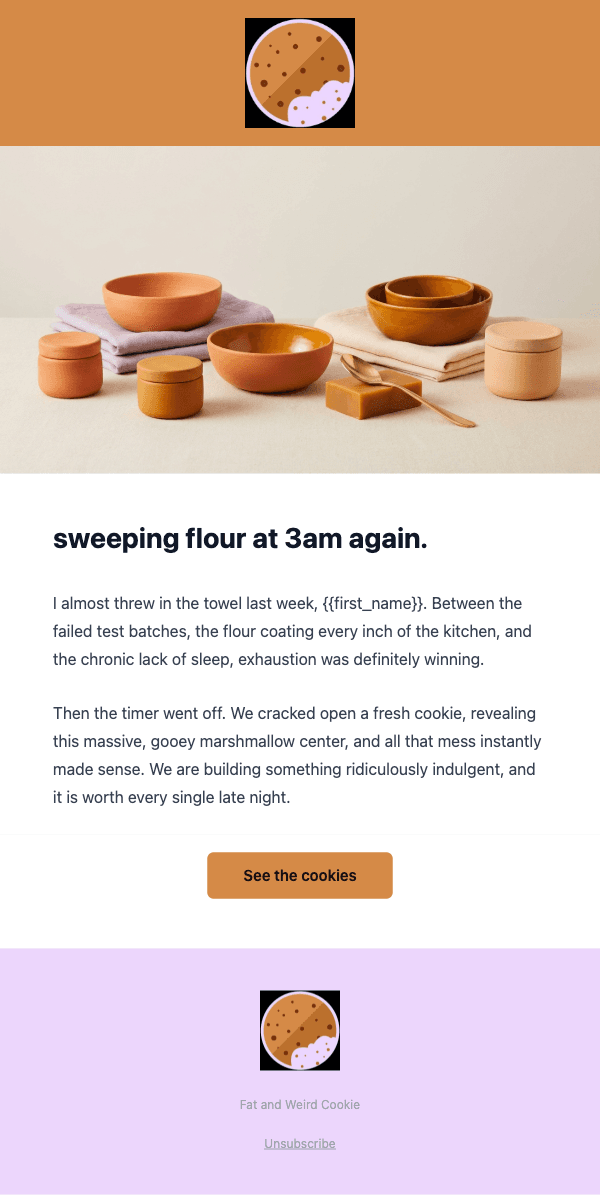
If you are ready to stop sending emails that could have come from anyone, see a live demo of SendKite and what on-brand AI email generation looks like for your specific store.